
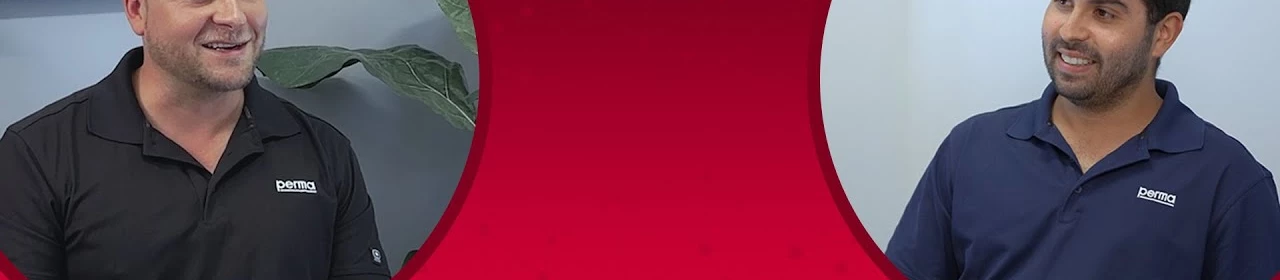
In the first episode of perma POWERTALK, Cody Decker, Strategic Account Manager at perma USA, sits down with Nick Krop from perma Australia to discuss lubrication technology, connected solutions and the differences between industrial markets in the United States and Australia.
Their conversation explores the growing role of digitalization in maintenance, the adoption of connected lubrication technologies such as LoRa and Bluetooth and how industries including mining, pulp and paper, automotive and aggregates are approaching lubrication and reliability.
What You’ll Learn in This Episode
- How the industrial landscape differs between the United States and Australia
- Why connected lubrication is gaining traction across industrial operations
- How LoRa and Bluetooth technologies are supporting more connected maintenance programs
- Why mining has been an early adopter of digital and connected solutions in Australia
- How maintenance teams are moving toward more automated lubrication processes
- What Cody and Nick are seeing across pulp and paper, mining, aggregates and automotive applications
Connected Lubrication Across Global Industrial Markets
Industrial facilities around the world face many of the same maintenance challenges, but the industries, facility footprints and adoption of new technologies can vary significantly by market.
In this episode, Cody and Nick compare their experiences working with industrial customers in the United States and Australia. While the two markets have important differences, both are seeing increased interest in connected lubrication solutions that can provide maintenance teams with greater visibility into lubrication activities.
Nick points specifically to Australia’s mining industry, where digitalization and connected technologies are becoming increasingly important across large industrial operations.
The Growing Role of LoRa and Connected Lubrication
Connected lubrication technologies can help maintenance teams move beyond processes that rely heavily on manual inspection and individual lubrication routes.
Cody and Nick discuss the growing interest in LoRa-based technology as well as Bluetooth-enabled solutions. Depending on the facility, connected lubrication systems may work within an existing customer network and gateway infrastructure or through a dedicated perma solution.
The goal is not simply to add technology. Greater connectivity can help maintenance teams improve visibility, make more informed maintenance decisions and support more consistent lubrication practices.
This framing is especially important for perma because it supports the brand's reliability and maintenance-efficiency positioning without suggesting that automation eliminates the need for monitoring.
Applications in Mining, Automotive, Pulp and Paper and Aggregates
Cody and Nick also discuss several of the industries they plan to visit while Nick is in the United States, including:
- Mining
- Aggregates
- Pulp and paper
- Automotive
Each environment presents different lubrication requirements, equipment layouts and maintenance challenges.
For Nick, the automotive industry is particularly interesting because of the density of lubrication points and the opportunity to compare lubrication programs, lubricant selection and maintenance practices with those used in Australia.
This section also gives us a natural place to add internal links to perma USA's relevant industry and application pages.
Moving Toward More Automated Maintenance Processes
One theme that comes through clearly in the conversation is the industry's broader move toward digitalization and more automated maintenance workflows.
Manual lubrication can become difficult to manage when facilities have large numbers of lubrication points, demanding production schedules or equipment spread across expansive operations. Automated and connected lubrication can help teams make lubrication more consistent while reducing the maintenance burden associated with servicing individual points manually.
For perma, I would be careful not to frame this as "manual versus good." The stronger message is that automation helps reduce guesswork, improve lubrication consistency and support a more planned maintenance approach.
Watch More perma POWERTALK Episodes
perma POWERTALK brings together maintenance, reliability and industry professionals to discuss lubrication technology, industrial applications and the changing needs of maintenance teams.
Episode Transcript
Prefer to read along? View the edited transcript of this perma POWERTALK conversation below.
Editing note: Filler words, repeated phrases and obvious transcription errors have been cleaned up for readability while preserving the substance and conversational tone of the episode.
Cody Decker: Welcome to the very first episode of perma POWERTALK. I’m Cody Decker, and I’m going to be the host today. When I’m not hosting podcasts, I’m out in the field across the U.S. as a Strategic Account Manager.
Cody Decker: Today we have Nick from Australia. He’ll introduce himself shortly. We’re excited to have him here, and after we leave the office today, we’re going to hit the road and visit some accounts. Nick, go ahead and introduce yourself, and we’ll get started.
Nick Krop: Thanks, Cody. I’m excited to be here today. As you mentioned, I’m Nick Krop from perma Australia. Same company, different region. My role includes application engineering, operations engineering, continuous improvement and sales in the New Zealand area as well.
Nick Krop: I’ve been in the industry for about eight years altogether, on and off. I started in operations in Australia and worked there for six years while I was studying at university. From there, I moved into the construction industry for about five years. Then I came back, and I’ve now been at perma Australia for two years in this particular role.
Cody Decker: So it’s definitely safe to say you wear multiple hats.
Nick Krop: Yes, I wear multiple hats.
Cody Decker: You’ve been here for a few weeks now and did some traveling before coming to perma USA in Charlotte. Before we head out to visit some customers and look at some of the LoRa applications, tell us a little about your trip. Did you go anywhere interesting or try any great food?
Nick Krop: Absolutely. I’ve actually been here for about four weeks and was lucky enough to come over with my partner. We started with a holiday before getting to perma USA here in Charlotte.
Nick Krop: Our first stop was the West Coast. We traveled around Utah in an RV, visited some national parks, went down to Louisiana for the food scene, then headed up to New York before coming down here. It’s been a very well-rounded trip, and I’ve really enjoyed it.
Cody Decker: That sounds great. I’m excited for what’s next. After the podcast, we’ll head out and visit some of the key sectors we work with at perma. They may be a little different from what you see in Australia, so hopefully you’ll get to do some sightseeing and see some key applications.
Cody Decker: You and I both work with a lot of the LoRa technology as LoRa Champions for the U.S., Australia and New Zealand. A lot of our conversations over the next few days will be about the new technology and how it’s working for customers. Some customers are using their own ecosystems and gateways, while others are using the perma solution.
Cody Decker: We’ll be visiting pulp and paper, automotive, aggregates and mining, so we’re going to see some exciting applications.
Nick Krop: It sounds very exciting. I think it will be quite different from the Australian market in terms of footprint and commercial density. The U.S. is very different from Australia in that respect. I’m also excited to see the differences in heavy industry, especially in the sectors you just mentioned.
Cody Decker: Recently, we launched our new LoRa technology, and it’s definitely making waves. We have a long list of customers interested in the United States, and you’ll get to see some of that over the next few days.
Cody Decker: When it comes to connected solutions, including Bluetooth, LoRa and some of the other technologies out there, what kind of traction are you seeing in Australia? Is it similar to what we’re seeing in the U.S.?
Nick Krop: I think so. There’s been a big wave in the industry, particularly in the mining industry in Australia, where we’re seeing a push toward digitalization and the use of connected solutions.
Nick Krop: We’ve definitely seen a similar level of interest, particularly among larger commercial accounts.
Cody Decker: For sure. As the workforce changes and more technology-savvy professionals move into these roles, we often see them leaning toward connected solutions in addition to the standard product lines we offer.
Nick Krop: Absolutely. There’s a move from manual processes toward less reactive, more automated workflows.
Cody Decker: Of the accounts we’re going to visit, including large paper mills, mining, aggregates and automotive, what are you most excited to see? What do you think will be most unique compared with Australia?
Nick Krop: For me, I think it would be the automotive industry. I’m interested in the differences in applications, the density of lubrication points, the lubrication programs being implemented and possibly the types of lubricants being used. That’s probably of the highest interest to me.
Cody Decker: It’s also great that we finally get to meet in person. Teams makes it easy to stay connected, but it’s nice to put a face to the name and shake hands. I’m excited to take this on the road.
Cody Decker: We had an interesting start with the LoRa rollout and the meetings between perma USA, perma-tec and perma Australia. Sometimes I was joining at 5:00 a.m., while you were joining very late at night.
Nick Krop: Yes, it was pretty late. I think perma-tec had the easier time slot. We definitely had the tougher end of the deal.
Cody Decker: They kept asking if we could move the meeting an hour earlier. I’d say, “Sure, 5:00 a.m. works,” while you were still joining around midnight.
Nick Krop: Yes, and trying to think things through at that hour wasn’t always ideal. But we got through it, and the product has launched, so it all worked out in the end.
Cody Decker: Absolutely. Thanks, everybody, for tuning in to our first episode of perma POWERTALK. Nick, thanks for coming all this way and helping us with our first episode. We have many more to come, and we’re excited about what’s ahead. Tune in for the next one.
Nick Krop: Absolutely. Happy to fly over anytime.
Find the Right Lubrication Solution for Your Application
Looking for ways to improve lubrication consistency, support equipment reliability or reduce the burden of manual lubrication? perma USA offers automatic lubrication solutions for a wide range of industrial equipment and operating environments.