


Equipment failure rarely happens without warning. In many cases, small issues begin building long before a machine stops, a bearing fails or production is interrupted. For maintenance and reliability teams, the challenge is not always knowing that lubrication matters. The challenge is having enough visibility to understand where lubrication issues may be developing.
Lubrication data can help close that visibility gap. When teams can better track lubrication status, service intervals, system activity and recurring problem areas, they can make more informed maintenance decisions and respond before small issues become larger equipment problems.
For facilities working toward more connected maintenance practices, lubrication data is one way to bring a traditionally manual task into a more visible, planned and proactive maintenance process.
What Is Lubrication Data?
Lubrication data is the information maintenance teams use to understand how lubrication is being managed across equipment, routes and lubrication points.
This may include:
- Lubrication point location
- Lubricant type
- Lubricant amount
- Service interval
- Completion history
- Missed or delayed tasks
- Refill or replacement needs
- System status
- Equipment condition notes
- Technician observations
In a manual process, this information may live in route sheets, spreadsheets, maintenance logs or technician notes. In a connected lubrication process, some of this information may also come from digital tools,connected lubrication systems or remote monitoring.
The value of lubrication data is not just collecting information. The value is using that information to understand what is happening in the field and where maintenance teams may need to take action.
Why Lubrication Data Matters for Equipment Reliability

Lubrication has a direct impact on equipment reliability. When lubricant is missing, delayed, contaminated, over-applied, under-applied or not matched to the application, components can experience more friction, heat and wear.
Without clear data, these issues can be difficult to catch early. A lubrication point may be missed repeatedly. A route may become outdated after equipment changes.
A technician may not have an easy way to confirm whether a point was serviced on schedule. A lubrication system may need attention, but the issue may not be visible until the next manual inspection.
Lubrication data helps maintenance teams move from assumption to visibility. Instead of relying only on memory or manual checks, teams can use lubrication information to identify patterns, confirm service history and prioritize the points that create the most risk.
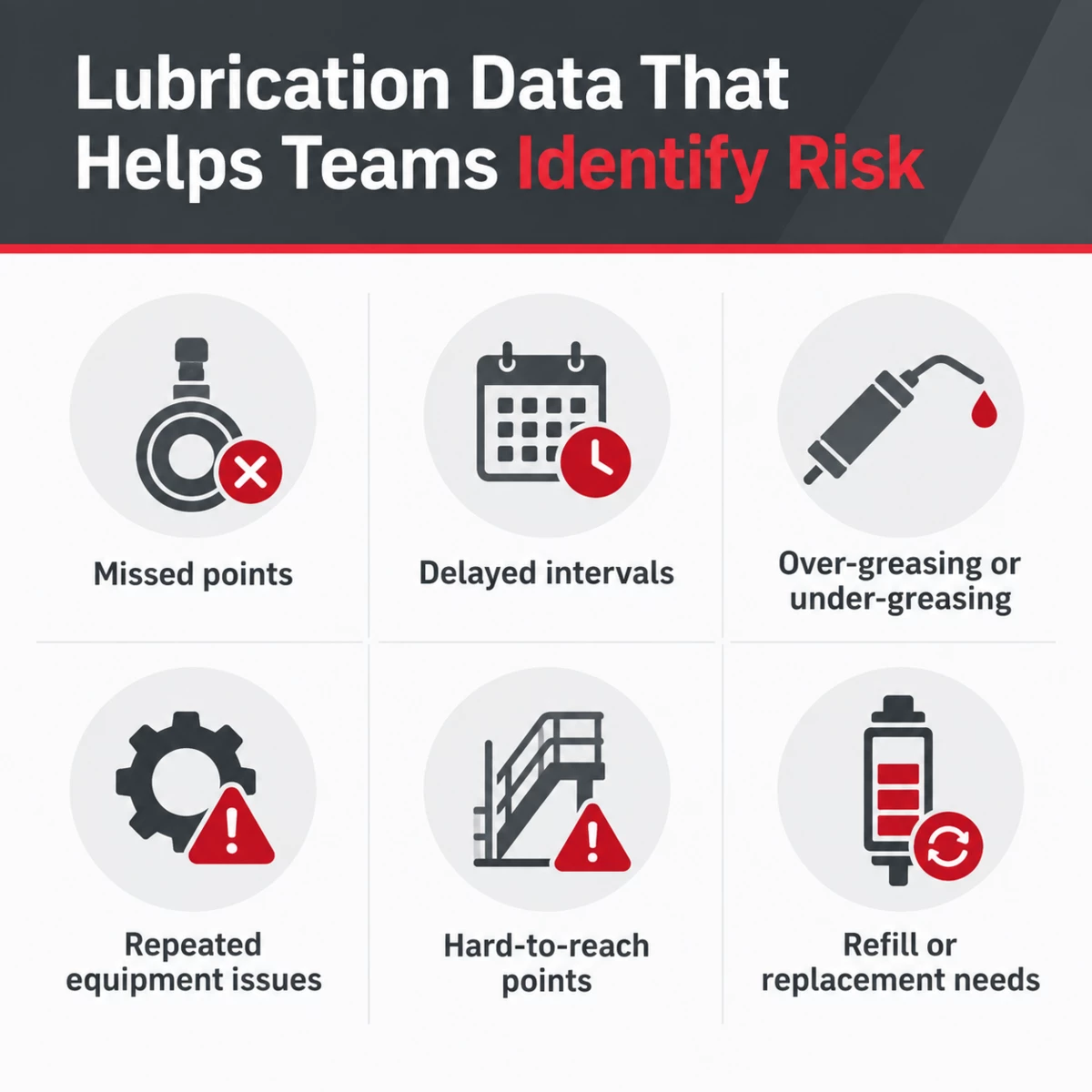
Common Lubrication Issues Data Can Help Reveal
Lubrication data can help teams identify issues that may otherwise go unnoticed until equipment performance changes.
Missed Lubrication Points
Missed lubrication points are often tied to hard-to-reach areas, complex routes, unclear documentation or time pressure.
Tracking missed or delayed service can help teams identify which points need better access, clearer instructions or a different lubrication approach.
Inconsistent Service Intervals
Some lubrication points require more frequent attention than others. If intervals are missed or delayed, components may operate without the lubrication they need during critical production periods. Tracking service intervals can help teams see where schedules are realistic and where adjustments may be needed.
Over-Greasing or Under-Greasing
Too much or too little lubricant can create equipment problems. Lubrication data can help teams confirm required amounts, document application practices and identify points where inconsistent lubricant volume may be creating risk. These issues are often connected tocommon lubrication mistakes that can be reduced with clearer documentation and more consistent practices.
Repeated Issues on the Same Equipment
If the same piece of equipment continues to experience lubrication-related issues, the problem may not be the task itself. It may be the interval, lubricant type, access point, operating environment or application method. Reviewing lubrication data over time can help teams spot repeated patterns.
Hard-to-Reach or High-Risk Points
Data can help confirm which points are consistently difficult to service. If a point is frequently missed, delayed or tied to safety concerns, it may be a strong candidate forautomatic lubrication or connected monitoring.
How Lubrication Data Supports Better Maintenance Planning
Lubrication data is most useful when it helps teams plan maintenance more effectively. Instead of treating every lubrication point the same, teams can use data to decide which points need more attention, which routes need improvement and which assets should be prioritized.
Lubrication data can support planning by helping teams:
- Confirm which points were serviced
- Identify missed or delayed intervals
- Review recurring lubrication issues
- Prioritize critical equipment
- Plan refills or replacements
- Improve route documentation
- Adjust service intervals based on actual conditions
- Identify points that may benefit from automatic lubrication
This helps maintenance teams move toward a more proactive process. The goal is not to create more paperwork or more data to manage. The goal is to make lubrication easier to track, easier to review and easier to improve over time.
For teams still working through manual route complexity, reviewinghow to simplify manual lubrication routes can be a practical first step before expanding connected lubrication or remote monitoring.
The Role of Connected Lubrication Systems
Connected lubrication systems can make lubrication data more accessible by giving teams better visibility into selected points. This can be especially valuable for points that are hard to reach, frequently missed, near moving equipment or tied to critical production assets.
For example, connected lubrication can help teams monitor system status, support remote visibility and plan service needs more efficiently. Instead of relying only on manual route checks, teams can use connected lubrication data to understand which selected points may need attention.
perma CONNECT helps support this type of digital lubrication management by giving teams visibility into connected automatic lubrication systems. For Bluetooth-enabled lubrication points,perma STAR VARIO BLUETOOTH can be operated through perma CONNECT and is compatible with Gateway BLUETOOTH.
For teams working toward Industry 4.0 or connected maintenance goals, this helps align lubrication with broader reliability and data visibility efforts.
Using Lubrication Data in an Industry 4.0 Maintenance Strategy
Industry 4.0 is focused on connected systems, better visibility and more informed decision-making across industrial operations. In maintenance, that often means using digital tools to understand equipment status, identify priorities and reduce unnecessary manual checks.
Lubrication data supports that approach by making a routine maintenance task more visible. Instead of treating lubrication as a disconnected manual process, teams can bring lubrication information into a broader maintenance workflow.
For more context on this shift, see our article onhow connected lubrication supports Industry 4.0.
Lubrication Data Does Not Replace Technician Expertise
Lubrication data is helpful, but it does not replace the knowledge and judgment of maintenance teams. Technicians still need to inspect equipment, confirm system setup, understand application conditions and adjust maintenance practices when equipment or production demands change.
Data is most valuable when it supports technician expertise. A report, alert or service history can help point teams in the right direction, but experienced maintenance professionals are still needed to understand what is happening at the equipment level.
This is especially important with automatic or connected lubrication systems. These systems can support consistency and visibility, but they still require proper installation, monitoring, refills, inspections and maintenance planning.

Which Lubrication Points Should Teams Track First?
Not every point needs the same level of tracking or connected visibility. Teams can start by focusing on the lubrication points that create the most risk, cost or manual burden.
Good candidates include:
- Critical equipment tied to production output
- Hard-to-reach lubrication points
- Points near moving equipment
- Frequently missed points
- Components requiring frequent lubrication
- Continuously running equipment
- Points with a history of lubrication issues
- Areas where manual access creates safety concerns
Starting with high-value points helps teams use lubrication data where it can make the biggest operational difference.
Turning Lubrication Data Into Action
Lubrication data only helps prevent equipment failure when teams use it to make decisions. Once problem areas are visible, maintenance teams can take practical steps to improve reliability.
These steps may include:
- Updating route documentation
- Adjusting lubrication intervals
- Confirming lubricant type and amount
- Improving technician access to hard-to-reach points
- Automating selected lubrication points
- Using connected monitoring for critical points
- Reviewing recurring issues during maintenance planning
- Training teams on updated lubrication procedures
The most important step is closing the loop between what the data shows and what the maintenance team does next.

Use Lubrication Data to Support a More Proactive Maintenance Strategy
Lubrication data gives maintenance teams more visibility into a task that is often difficult to manage manually. By tracking service history, system status, missed intervals and recurring issues, teams can identify risk earlier and make more informed maintenance decisions.
While lubrication data alone cannot prevent every equipment failure, it can help teams improve consistency, prioritize high-risk points and support a more proactive maintenance strategy. It can also help teams move away fromreactive maintenance by making lubrication needs easier to see, plan and address.
Looking for ways to improve lubrication visibility and reduce avoidable equipment issues?Contact perma USA to explore connected automatic lubrication options for critical, hard-to-reach or frequently monitored lubrication points.
Sources
- Machinery Lubrication. (n.d.). Lubrication best practices. Retrieved September 8, 2026, fromhttps://www.machinerylubrication.com/Read/28935/lubrication-best-practices
- National Institute of Standards and Technology. (2016). An analysis of technologies and standards for designing smart manufacturing systems.https://doi.org/10.6028/jres.121.021